
When you look at dental implants before and after photos, the difference can be incredible. Missing teeth are replaced. A smile that was once hidden looks whole again. But what you see in those two photos only tells part of the story.
For many people living with missing teeth, tooth loss, failing natural teeth, or ongoing dental problems, the transformation goes far beyond a beautiful smile. Dental implant treatment can change the way someone eats, speaks, smiles, and feels in everyday life. Things that once required a second thought—ordering a favorite meal, laughing in a photo, or simply smiling during a conversation—can begin to feel natural again.
At Graf Dental Surgery, we've seen firsthand how a new smile can impact a patient's daily life. With today's advancements in implant dentistry, digital planning, and dental implant treatment, full-mouth solutions like All-on-X can provide a fixed, long-term option for patients who are ready to move beyond failing teeth or removable tooth replacements.
In this article, we're sharing real dental implants before and after transformations and taking a closer look at what happens between those two photos—from the initial consultation and treatment plan to the healing process and final restoration. You'll also learn what to look for in real patient results, what makes someone a good candidate, and what goes into creating a natural-looking smile designed specifically for the person wearing it.
Because the final result isn't simply about replacing teeth. It's about what becomes possible when you're ready to smile again.
When you first look at dental implants before and after photos, your eyes naturally go straight to the teeth. You notice the missing teeth that are now replaced, the change in shape and color, and the difference a complete smile can make. But some of the most meaningful changes aren't as easy to capture in a photo.
For someone who has experienced significant tooth loss, severely damaged natural teeth, or years of complicated dental work, everyday decisions can start revolving around their teeth. What can I eat? Will people notice when I smile? Is this tooth going to cause another problem? For some patients, even routine dental care can begin to feel like an endless cycle of repairing one problem only for another to appear.
All-on-X treatment takes a different approach. Rather than replacing each missing tooth individually, a carefully planned number of implants can support a fixed full-arch prosthesis, replacing an entire upper or lower arch of teeth. For the right patient, this can provide a stable, fixed solution designed to restore both function and appearance.
That means the goal isn't simply a set of new artificial teeth. The goal now is creating a smile with the right size, shape, and proportions for the individual patient—one that complements their features and creates a more natural look. The final result should feel personal, not like the same smile was given to everyone. With our in-house lab, creating personalized, custom implants has never been easier.
And that's where the real transformation begins. A new smile can make eating, speaking, laughing, and being present in photos feel different. The before-and-after pictures may show the physical change, but they can't fully show what that change can mean in someone's daily life.
Ready for a complete smile solution? Learn more about complete smile restoration here.
Before-and-after photos can be one of the best ways to understand what is possible with dental implant treatment—especially when you're looking at real patients rather than stock photos. But a great result isn't simply about having whiter or straighter teeth. There are several details that come together to create a smile that looks like it belongs to that person.
One of the biggest concerns patients have is whether their artificial teeth will actually look natural. The goal shouldn't be to create a smile that looks "too perfect." It should be to design teeth with a size, shape, shade, and proportion that complement the patient's individual features.
When comparing dental implant before-and-after photos, look at the smile as a whole. Do the teeth appear to be the right size for the patient's face? Does the shape feel natural? Does the smile complement the person rather than overpower their features?
Thoughtful planning and customization can create a natural-looking smile that closely mimics the appearance of healthy natural teeth while still giving the patient the opportunity to choose characteristics they love about their new smile.
The teeth themselves are only one part of the final result. The relationship between the restoration, gum tissue, lips, and overall facial structure also plays an important role in how natural the smile appears.
This becomes especially important for patients who have experienced significant tooth loss, gum disease, or changes in the bone and soft tissue surrounding their teeth. Every patient's starting point is different, which is why the final restoration should be planned around their individual anatomy rather than trying to recreate the exact same smile for everyone.
When viewing before-and-after photos, pay attention to how the upper teeth and lower teeth fit within the patient's smile and face. A successful transformation isn't just about replacing what was lost. It's about creating balance and a natural-looking result.
Perhaps the most important part of a dental implant transformation is the part a photograph can't show.
You can't see how it feels to bite into food without worrying about a loose tooth. You can't see the relief of no longer trying to hide missing teeth when talking to someone. And you can't fully capture what it means to smile for a family photo without immediately thinking about your teeth.
Restoring a smile can affect function, oral health, confidence, and the small everyday moments that are easy to take for granted. That's why the most meaningful dental implants before and after transformations aren't always measured by how different the two photos look.
Sometimes, the biggest difference is what the patient is able to do after the photo is taken.
No two smiles begin in exactly the same place—and no two dental implant transformations should look exactly the same.
Patients may come to us with missing teeth, failing natural teeth, advanced tooth loss, or a full set of teeth that can no longer be predictably restored with traditional dental care. Their needs may involve the upper teeth, lower teeth, or a complete full-mouth restoration.
That's why looking at several real before-and-after results can be helpful. Rather than focusing on one "perfect" outcome, these photos show how different starting points can lead to smiles that are designed around each patient's individual features and needs.
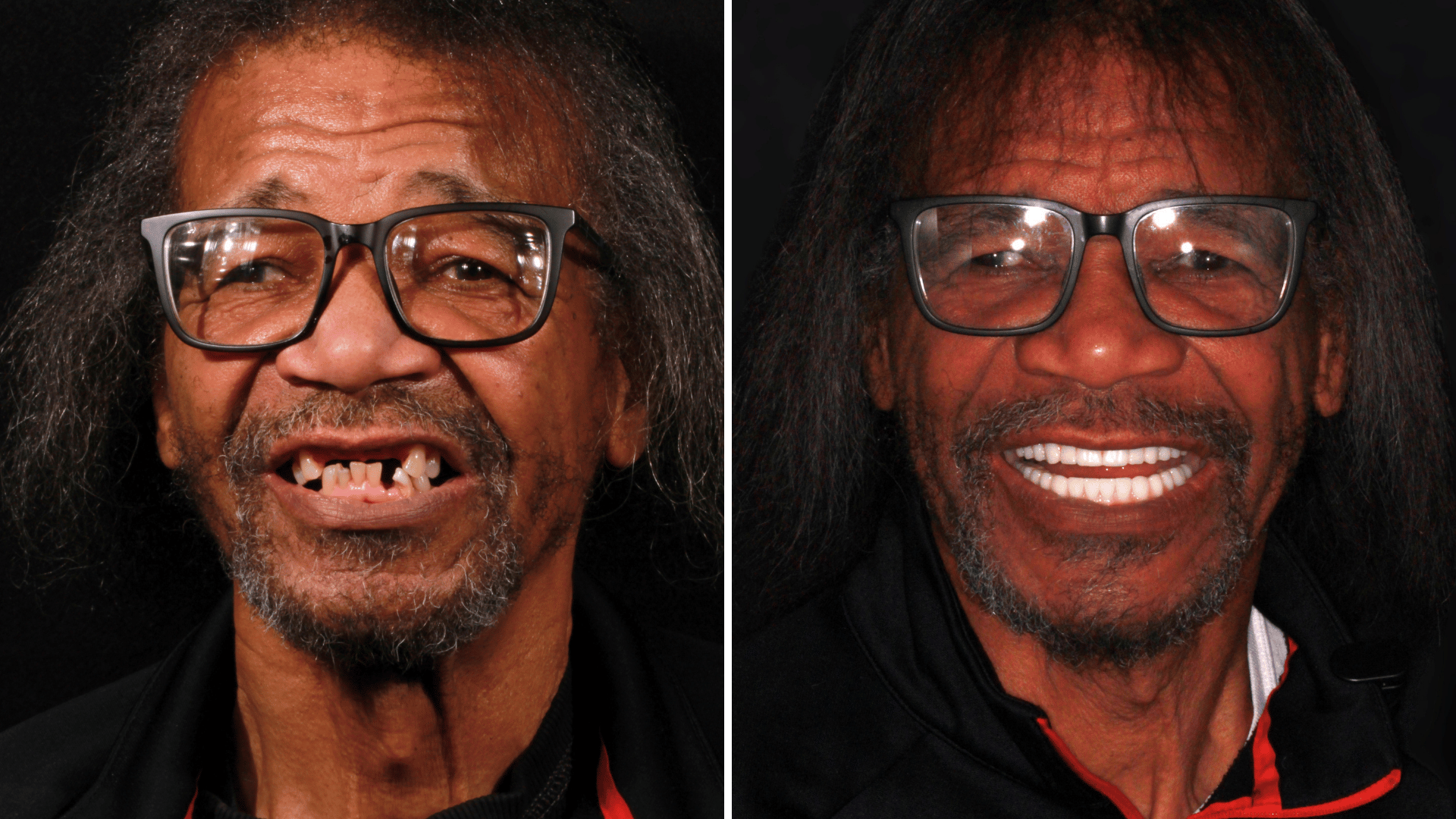
The goal of All-on-X isn't to give every patient the same set of teeth. The treatment plan and final smile are customized to each person's anatomy, available bone, facial features, and desired appearance. From the shape and size of the teeth to the details of the final restoration, each case presents a unique situation.
Before and after photos show the visible final result. But there's an entire process of planning, treatment, and healing that happens between the "before" and the "after."
So, what actually happens between those two photos?
A dramatic before-and-after transformation doesn't happen by simply replacing missing teeth with a standard set of artificial teeth. There is careful planning behind every smile, beginning well before dental implant surgery and continuing through the healing process and placement of the final restoration.
While the entire process varies based on each patient's needs, here's a closer look at what typically happens between the "before" and "after."
The first step is an initial consultation to understand where you're starting and what you hope to change. During your first visit, we'll evaluate your teeth, gums, bite, oral health, medical history, and bone health to determine which treatment options may be appropriate for you.
Advanced imaging, including CBCT scans, gives us a detailed three-dimensional view of structures that can't be fully evaluated by looking inside the mouth alone. This advanced technology allows us to assess the available bone in the upper jaw or lower jaw and identify important anatomical structures before treatment begins.
From there, digital planning helps determine details such as implant position, the number of implants needed, and the design of the new teeth. Because every mouth is different, this treatment plan is created around the patient's unique situation rather than using the same approach for every smile.
During dental implant placement, implants are positioned within the jawbone to create a stable foundation for the new teeth. Dental implants commonly use titanium posts, which are designed to integrate with the surrounding bone during healing.
With All-on-X treatment, multiple implants work together to support a fixed full-arch prosthesis. This is different from replacing a single missing tooth with an individual replacement tooth or implant-supported crown.
When appropriate, All-on-X can use an immediate-load implant approach, allowing a temporary set of teeth to be attached after implant placement rather than leaving the patient without teeth during the early stages of healing. These temporary teeth are an important part of the process, but they aren't the final result.
After the dental implant procedure, the body needs time to heal and for the implants to become stable within the jawbone. The length of the healing period can vary depending on factors such as the patient's overall health, bone quality, treatment performed, and how their body responds to surgery.
For some patients, additional treatment such as bone grafting may be recommended when there isn't enough bone to support the planned implants. This is one reason a detailed evaluation and individualized treatment plan are so important.
Once healing has progressed appropriately, attention turns toward the final restoration. This is where the details you notice in dental implant before-and-after photos—the size, shape, shade, proportions, and overall appearance of the teeth—come together.
The goal is more than simply filling the spaces where teeth used to be. It's creating a stable dental restoration that functions well and gives the patient a natural-looking smile designed for long-term use with proper care.
One of the most common concerns about teeth implants is whether the finished smile will actually look natural. Patients don't want teeth that simply look better than what they had before—they want a smile that looks like it belongs to them.
With All-on-X, the teeth you see immediately after dental implant surgery are not necessarily the teeth you'll have as your final restoration. The months between the initial procedure and the finished smile give the mouth time to heal while also providing an opportunity to refine the appearance, fit, and function of the new teeth.
When the patient's treatment allows for it, temporary teeth may be placed following implant surgery. These serve an important purpose during the healing period, allowing patients to leave with a fixed smile while the implants and surrounding tissues heal.
But a temporary smile is just that—temporary.
As the gum tissue and soft tissue change throughout the healing process, the way the restoration fits and looks can change too. The temporary teeth also give the dental team an opportunity to evaluate factors such as the bite, tooth position, appearance, and function before creating the final restoration.
Once healing has progressed appropriately, the final dental prosthetic can be designed using everything learned throughout that process. The goal is a durable, comfortable restoration that looks much more like natural teeth than many patients expect.
Creating a natural-looking result isn't as simple as choosing a tooth shade from a chart. Tooth size, shape, position, proportions, and the amount of teeth that show when someone smiles all contribute to the finished appearance.
A person with smaller facial features may need a very different tooth shape and right size than someone with a broader smile. The appearance of the upper front teeth, the relationship between the upper and lower teeth, and the way the smile follows the lips can all influence the design.
The type of material used for the final restoration can also affect its appearance, feel, and durability. Depending on the individual treatment plan, different restorative materials may be considered when creating a fixed full-arch prosthesis.
Ultimately, the goal isn't to create the whitest or most perfectly uniform teeth possible. It's to create a new smile that complements the patient's face and provides a more natural look.
That's why the best dental implant before-and-after results don't necessarily make you think, "Those are beautiful implants."
They make you think, "That's a beautiful smile."
Before-and-after photos are powerful because they make the physical transformation easy to see. But some of the biggest changes after dental implant treatment can't be captured with a camera.
For someone who has lived with missing teeth, failing teeth, or uncomfortable implant-supported dentures or other removable tooth replacements, dental problems can quietly affect everyday decisions. You may avoid certain foods, smile differently in photos, cover your mouth when you laugh, or think about your teeth every time you meet someone new.
A fixed full-mouth solution can change those small moments.
It's being able to smile without first wondering what someone else sees. It's feeling more comfortable sitting across the table from someone. It's enjoying foods that may have been difficult to eat before. It's having a smile that feels like part of you rather than something you're constantly trying to hide.
And while All-on-X can provide a fixed solution for replacing failing or missing teeth, the goal isn't simply to give someone a new set of artificial teeth. It's to restore function while creating a beautiful smile that allows patients to get back to living their daily life with fewer thoughts centered around their teeth.
Of course, dental implants still require ongoing dental care. Maintaining good oral hygiene, following your dental team's instructions, and keeping up with regular dental visits are all important parts of protecting your oral health and supporting the long-term success of your restoration.
A dental implants before-and-after photo can show you how much a smile has changed. But it can't show you the first time someone smiles for a photo without trying to hide their teeth. It can't show you the meals they enjoy again, the conversations they enter without hesitation, or all the moments when they simply stop thinking about their teeth.
That's the transformation we're really after—not just a new smile, but the freedom to live your life without your teeth holding you back.
Schedule a consultation with our team and learn what smile solutions are possible for you!
We look forward to meeting you. Call (740) 672-5893 today or request an appointment online to set up your first visit. We’ll be in touch soon.


